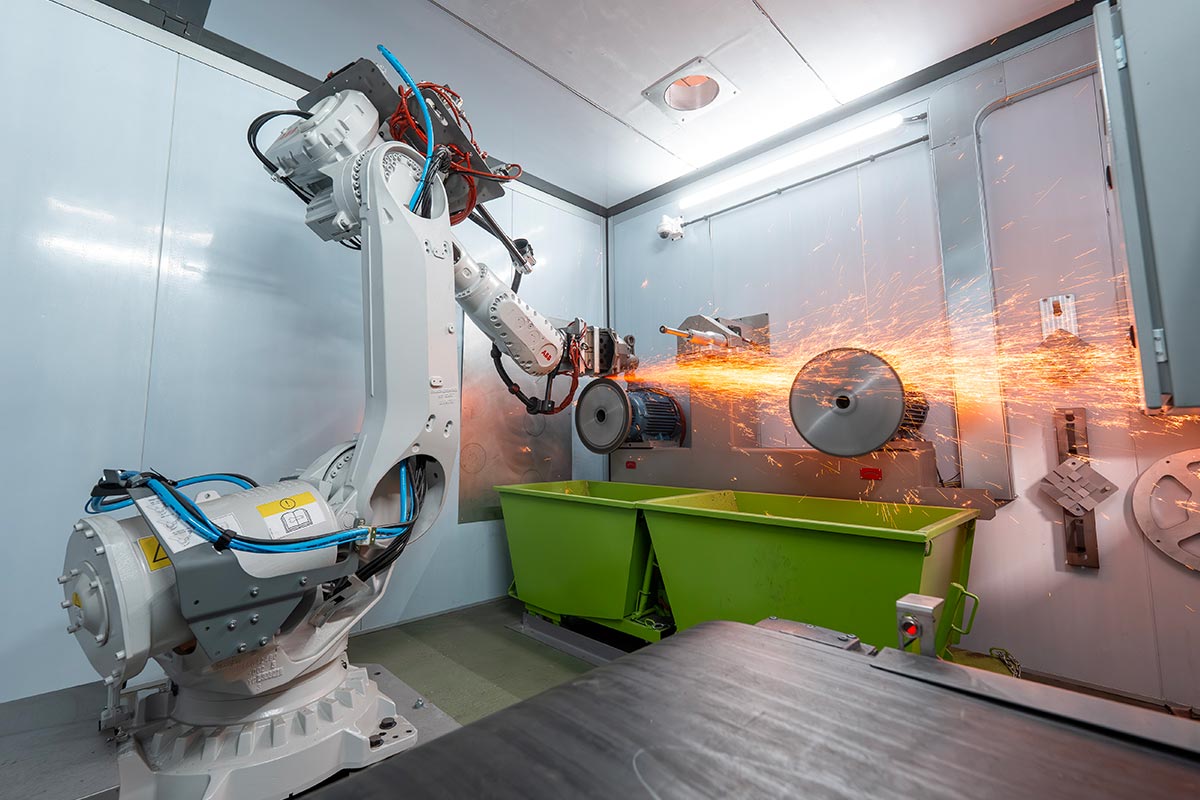
You can modernize a foundry without tearing up the workshop. The strategy that works involves identifying the bottleneck slowing down overall production and upgrading it first: adding a robotic cell next to an existing machine, integrating machine vision onto the line, implementing offline programming, or enabling remote maintenance. The rest of the equipment fleet keeps running. Here is how to approach it—and the costly mistakes to avoid.
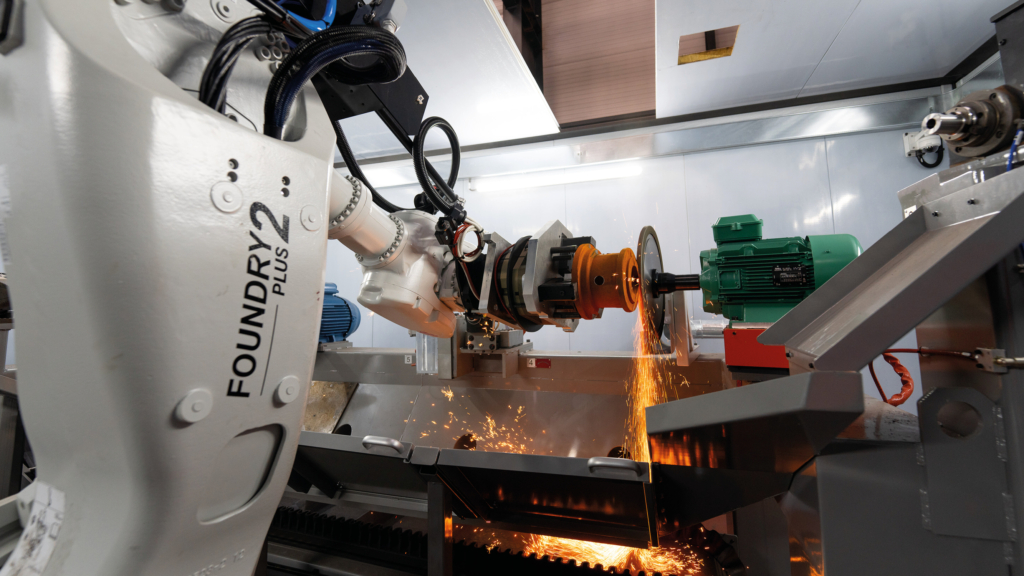
A modern robotic finishing cell can be integrated into an existing facility without replacing the entire machinery fleet
1. Why modernize in stages rather than replacing everything?
An older asset is not an obsolete asset
A twenty-year-old shakeout machine or a well-maintained trimming press can still perform reliably for years. What ages the fastest is rarely the mechanical structure; it is the control systems, the material handling around the machine, and the lack of data transparency. Manual workstations surrounding the equipment also tend to lag behind. Modernizing a foundry often means upgrading the processes around the machines rather than the machines themselves.
The true cost of a complete replacement
Equipment costs are only part of the invoice. A full replacement requires extensive civil engineering, workflow relocation, weeks of production downtime, and requalifying parts with OEMs and tier-1 customers. For a foundry supplying the automotive or rail sectors, this requalification phase alone can take months.
Stepped modernization spreads out capital expenditures (CapEx) and limits risk: each phase must prove its ROI and operational efficiency before the next one is launched.
2. Where to start: finding the workshop bottleneck
The right criterion: the bottleneck, not the oldest machine
The instinct is often to replace the equipment that looks the oldest. However, the fastest productivity gains almost always come from addressing the workstation that restricts throughput across the entire line. In most foundries, this bottleneck is located in finishing: deburring, grinding, and gating removal. These are arduous tasks, difficult to staff, and prone to quality variations from one operator to the next.
An assessment in five questions
Before budgeting any project, answering these five questions will help frame the scope:
-
Which workstation accumulates the highest volume of work-in-process (WIP)?
-
Where are rework loops, scrap rates, and customer complaints concentrated?
-
Which workstations experience the highest turnover, absenteeism, or ergonomic restrictions?
-
What are the part families (alloy, weight, geometry) and their annual volumes?
-
How much physical space is actually available around the targeted workstation?
The answers generally point to a single priority workstation. That is where the first project should take place.
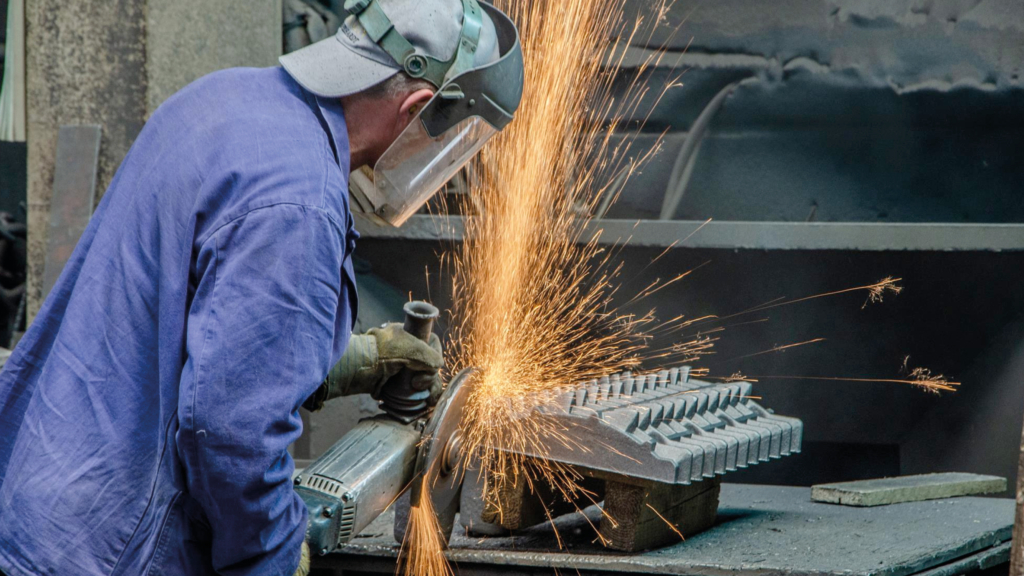
Operator working at a manual deburring station
3. Four levers to modernize without replacing everything
Install a robotic cell on an existing station
This is the most visible lever. A robotic finishing cell can replace one or several manual workstations without disrupting upstream molding or desanding operations. Standardized cells (such as the SiiF ECO range) reduce capital investment and lead times. For heavy components, dedicated heavy-duty cells (SiiF HEAVY) can handle parts weighing up to 15 tons. The plant keeps its core machines, material flows, and teams; only the most constrained workstation undergoes a transformation.
Integrate machine vision on the line
A 2D or 3D camera can be integrated into a robotic cell—either at the infeed or inside the workspace. This technology unlocks multiple capabilities:
-
Precisely locating the cast part prior to machining.
-
Managing high-mix production batches with the potential addition of infeed and outfeed conveyors.
-
Detecting residual flash by comparing parts against a digital reference model.
-
Collecting actionable production data for every single part.
3D vision is frequently the most cost-effective way to meet customer traceability requirements without multiplying standalone quality controllers. Industrial vision and quality control solutions can be seamlessly retrofitted onto existing SERF or SiiF installations.
Use offline programming to prevent production downtime
A common concern in multi-reference foundries is spending hours reprogramming robots for every new part while the cell sits idle. By utilizing offline programming (OLP) software (such as RobotStudio or Roboguide), new production runs are prepared and optimized without tying up shop floor assets. From designing workholding fixtures and grippers to optimizing finishing trajectories, the entire process is engineered and validated upstream.
-
The Result: Faster on-site integration, minimized downtime, and maximized equipment availability.
Connect equipment for remote support
Equipment connected directly to its supplier can be troubleshot much faster. Remote maintenance (telemaintenance) makes it possible to diagnose faults, adjust parameters, or update software programs without waiting for a technician to travel on-site. For isolated foundries or plants running multi-shift operations, this is often the difference between a one-hour pause and a two-day shutdown.
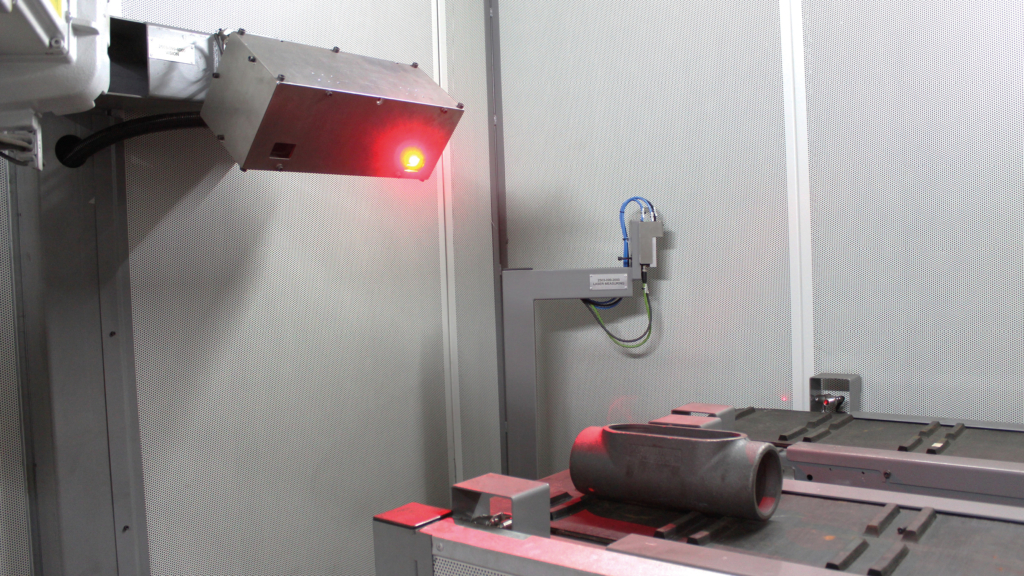
3D vision systems can be retrofitted onto existing SiiF robotic cells
4.Pitfalls of progressive modernization
Underestimating integration in existing facilities
A foundry building was rarely designed to house a robotic cell from the start. Overhead crane clearance, pits, dust, ambient heat, noise, and forklift traffic must all be re-evaluated before engineering the cell. Safety perimeters around neighboring machinery must also be verified. Modifying an existing production line may require reassessing compliance standards. An integrator with deep foundry experience will conduct this audit on-site, not just on paper.
Forgetting the workforce
A robotic finishing cell that is poorly accepted or improperly operated can yield lower output than a motivated operator. The best projects involve finishing operators right from the feasibility study phase: they know the difficult parts and recurring casting defects. Naturally, they then become the primary cell operators and champions. Training must be planned from day one to support teams in mastering the new cells and production lines, allowing them to effectively understand, operate, and maintain the newly installed finishing solutions.
Trying to connect everything before securing a win
Hooking every machine up to a central manufacturing execution system (MES) is tempting. However, without a first modernized, profitable workstation, this initiative can quickly bog down. A measurable ROI achieved in six months is far more valuable than a comprehensive architecture that is never fully deployed.
5. What does a successful modernization look like?
The most common path forward unfolds in three phases:
-
First Station: The identified bottleneck is automated, accompanied by operator training. Throughput, scrap rates, and absenteeism are measured before and after implementation.
-
Extension or Second Cell: Cell enhancements (vision systems, conveyors, offline programming) or a secondary cell are implemented, partially funded by the gains from the first project.
-
A Coherent Line: Modernized workstations are interlinked (part transfer, production data sharing) where it makes operational sense for the plant.
There is no obligation to reach the third phase. For many foundries, one or two well-placed cells are enough to completely transform the plant’s economic equation.
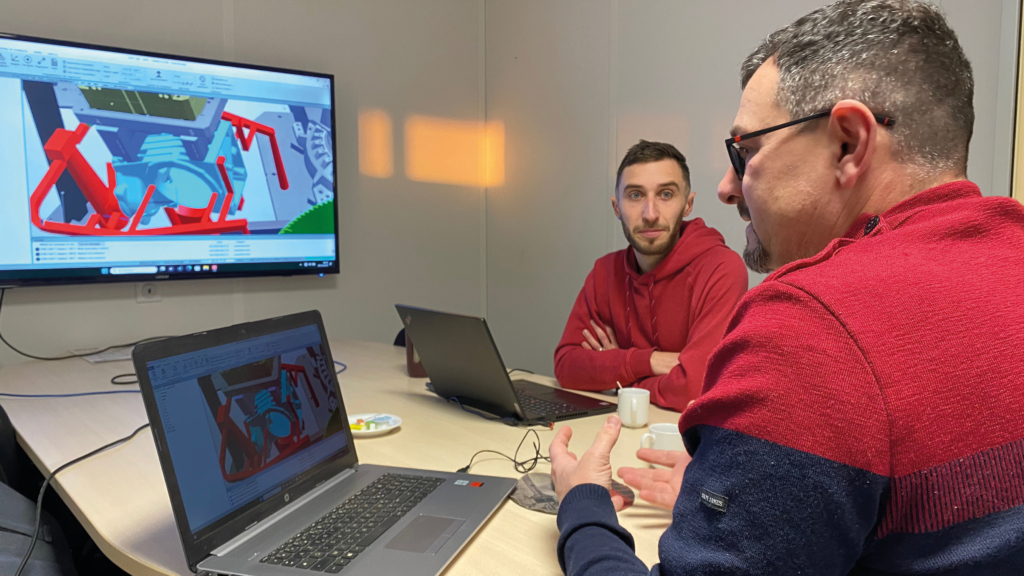
Workforce training ensures seamless equipment integration
Conclusion
Modernizing a foundry is not a question of total budget, but of operational priorities. The right first project is the one that unblocks the line, relieves operator strain, and delivers rapid, measurable results.
For over forty years, equipment manufacturers like SiiF have designed and assembled finishing solutions for iron, aluminum, and steel alloy foundries, integrating seamlessly into existing plants and supporting teams long after commissioning.
FAQ: Modernizing a Foundry
Can a foundry be modernized without stopping production?
Yes, for the most part. A robotic cell is assembled and fine-tuned in the supplier’s facility before being installed on-site following customer sign-off. Plant downtime for the targeted station is limited strictly to the installation and commissioning phase, while the rest of the shop floor keeps running.
Do I need to replace all my machinery to automate a foundry?
No. You can add a robotic cell, integrate a 3D vision system into an existing cell, or set up remote maintenance capabilities alongside your legacy equipment. Equipment replacement is only justified if a machine is limiting production speed or failing to meet strict quality and safety standards.
Which workstation should be prioritized for foundry modernization?
Start with the workstation that creates the bottleneck across the entire line. In most foundries, this is the finishing department—specifically deburring and deflashing—as it is the most manual, physically demanding, and hardest position to staff.
Can a robot be installed in an older plant?
Yes, provided there is a precise pre-engineering audit of existing constraints before the feasibility study: available floor space, crane clearance, dust, heat, material flow, and safety clearances for adjacent machinery. Compact, standardized cell configurations exist specifically to fit into constrained or uniquely laid-out facilities.
Is robotics profitable for a small, high-mix foundry?
It can be, provided the finishing cell is versatile and part changeovers are rapid. Offline programming makes it possible to prepare trajectories for new components without idling the cell, making automation practical even for moderate production runs.
How long does a modernization project take?
It depends on the scope. A first automated workstation can typically be completed in a few months, from initial engineering to commissioning and operator training. Subsequent phases then roll out at a pace dictated by the returns achieved.