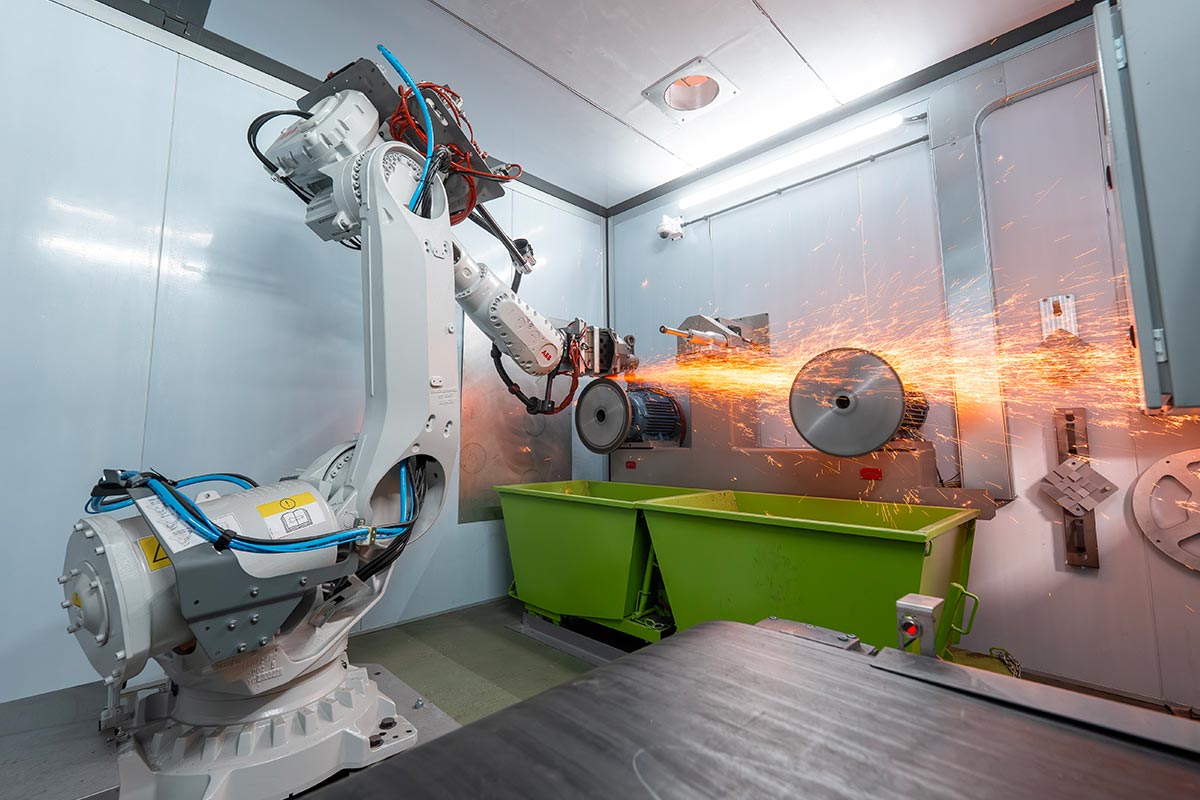
In a foundry, the part that exists the mold is never the part delivered to the customer. Between those two points lie numerous operations: core settings, cooling, decoring and shakeout, robotic finishing, trimming, sawing, vision systems, quality control, … All of these steps fall under the umbrella of foundry finishing.
It is often the most labor-intensive area in the entire facility, and paradoxically one of the least automated (even as melting and molding are already well underway with their technological transformation.
Labor shortages in physically demanding jobs, increasingly strict quality requirements from automotive, aerospace, or rail OEMs, and cost pressures from global competition: there is no shortage of reasons to look into foundry finishing automation. Which processes should be automated first? With which technologies? Based on what criteria, and with what limitations? That is the purpose of this guide.
01/ What is foundry finishing and why automate it ?
The operations that make up foundry finishing
Finishing encompasses a set of distinct post-casting operations applied to a raw casting to make it compliant and ready for delivery or final machining at the customer’s facility:
- Core settings
- Cooling systems
- Robotic finishing
- Trimming
- Sawing and pre-machining
- 2D / 3D vision systems
- Quality control
These activities do not form a single, mandatory process. Each responds to a specific neef that depends primarily on the casting process and the type of component. A sand casting requires sand removal and shakeout; a permanent mold, high/low-pressure die casting, or investment casting part does not. Nor do all parts require sawing or pre-machining, depending on the presence of large risers and customer specifications.
Finishing automation therefore does not mean building a continuous line that forcibly links all these activities together. A foundry can easily automate just one operation (the most relevant for its needs) and optionally add a 3D vision system without altering the rest. We will return to this point later in this article.
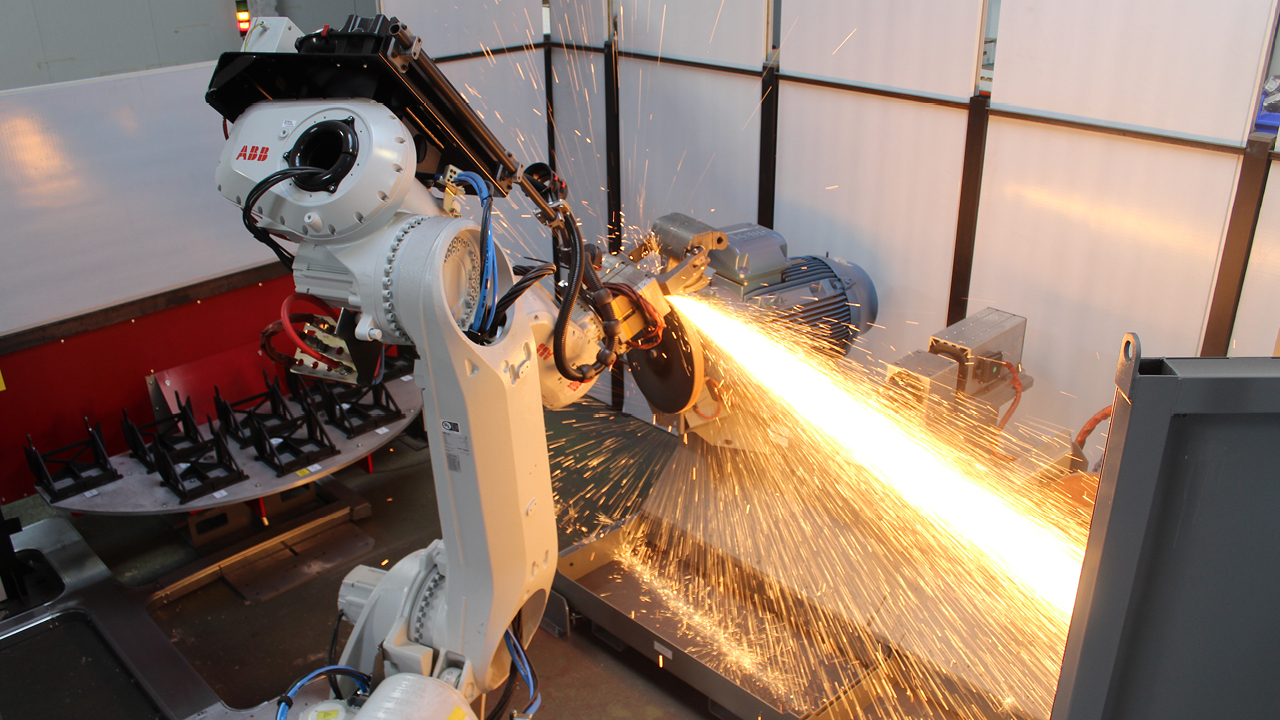
Casting finishing encompasses all operations between mold removal and part delivery.
Today, three major pressures are driving foundries to focus on these operations:
- Physical strain and labor shortages in grinding, deburring and shakeout stations
- Rising quality and traceability demands from key OEMs
- Competitiveness against lower-cost countries
We previously covered this broader workshop transformation context in our articles on foundry digitalization and Industry 4.0. Here, we focus on these finishing operations individually.
What automation concretely changes for the workshop ?
Automating a finishing operation isn’t just replacing a pair of hands with a robot arm. It transforms how the workstation operates: cycle times stabilize or shorten, finishes become more repeatable from part to part, and production data can be automatically logged for traceability.
It also reshapes workshop roles. Operators previously assigned to manual grinding or sawing are graduallu reassigned to cell supervision, programming, or quality control (higher value-added tasks that are generally less physically demanding).
02/ Which finishing operations can be automated in a foundry ?
Here is an operation-by-operation breakdown of what can concretely be automated. No foundry is expected to integrate every activity listed above into its industrial process. However, if your project involves several of these operations, they can be assembled into a single cohesive production line tailored to your specific needs.
Core settings
In sand casting or refractory mold processes, part quality is partly determined before metal is even poured. Once cores (which form internal cavities) are positioned, the mold sections must be assembled, aligned, and clamped together before molten metal is poured. This operation is known as core settings.
It directly impacts the success of the pour. An improperly closed or clamped mold can leak molten metal through parting lines, prevent gas evacuation, or suffer cope lift under fluid pressure. All these issues manifest as defects on the cast component after shakeout.
Handling molds remains one of the most physically demanding jobs on the floor: mold sections are heavy, yet alignment requires precision. Automatign mold closing using robotic arms adresses both challenges. Clamping force and alignment are replicated to the millimeter from mold to mold, minimizing assembly-related defects while relieving operators of heavy, repetitive lifting linked directly to musculoskeletal disorders (MSDs).
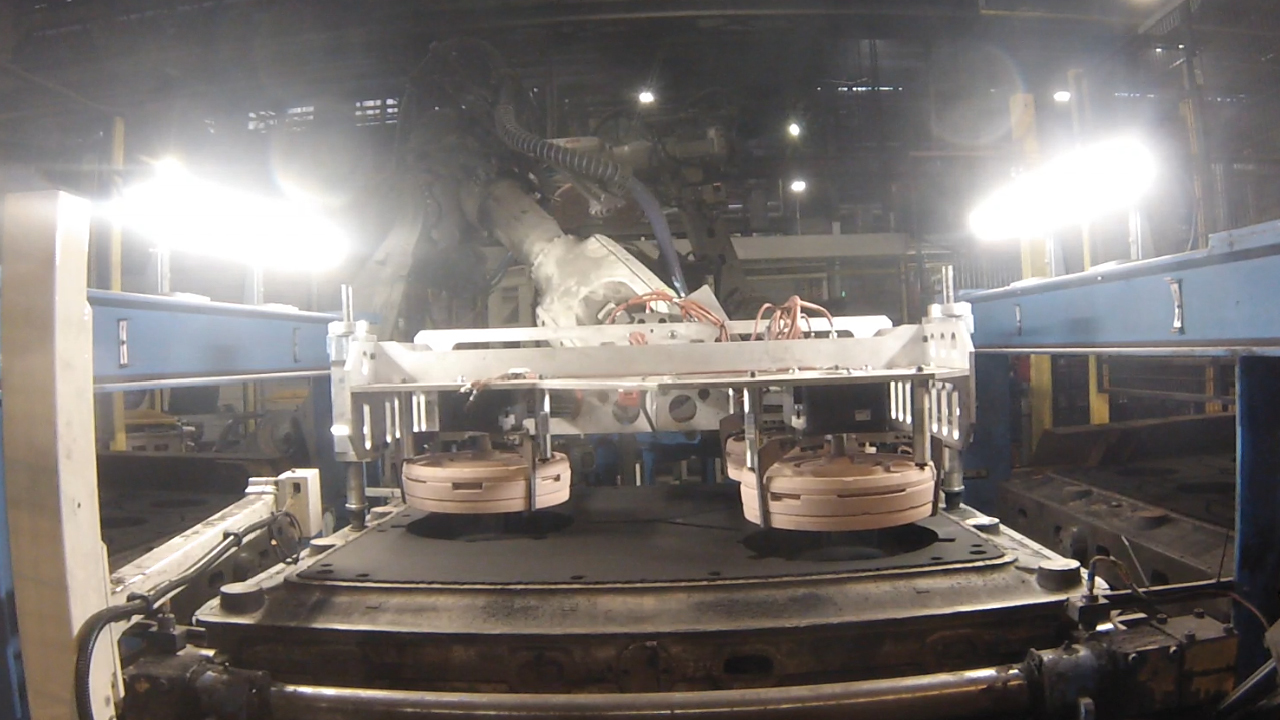
Core settings
Cooling systems
Regardless of the casting process, a component must cool sufficiently to be handled without risk of deformation or thermal shock.
Automating this step typically involves integrating fully robotic cooling carousel, water mist, or cooling tank. While dedicated equipment exists for aluminum castings, this automated process is less common than other operations discussed here.
Decoring and Shakeout
For sand-cast parts, once cooled, the casting must be separated from the molding sand and internal cores. Performed manually, this is one of the harshest environments in the foundry, exposing workers to dust, severe vibration, and high noise levels. Permanent mold or investment casting processes do not use sand and skip this step.
Automated decoring relies on shakeout and decoring equipment combining vibration, air extraction, and sometimes shot blasting for uniform sand removal. Crucially, it ensures part-to-part consistency, reducing downstream manual rework and worker exposure.
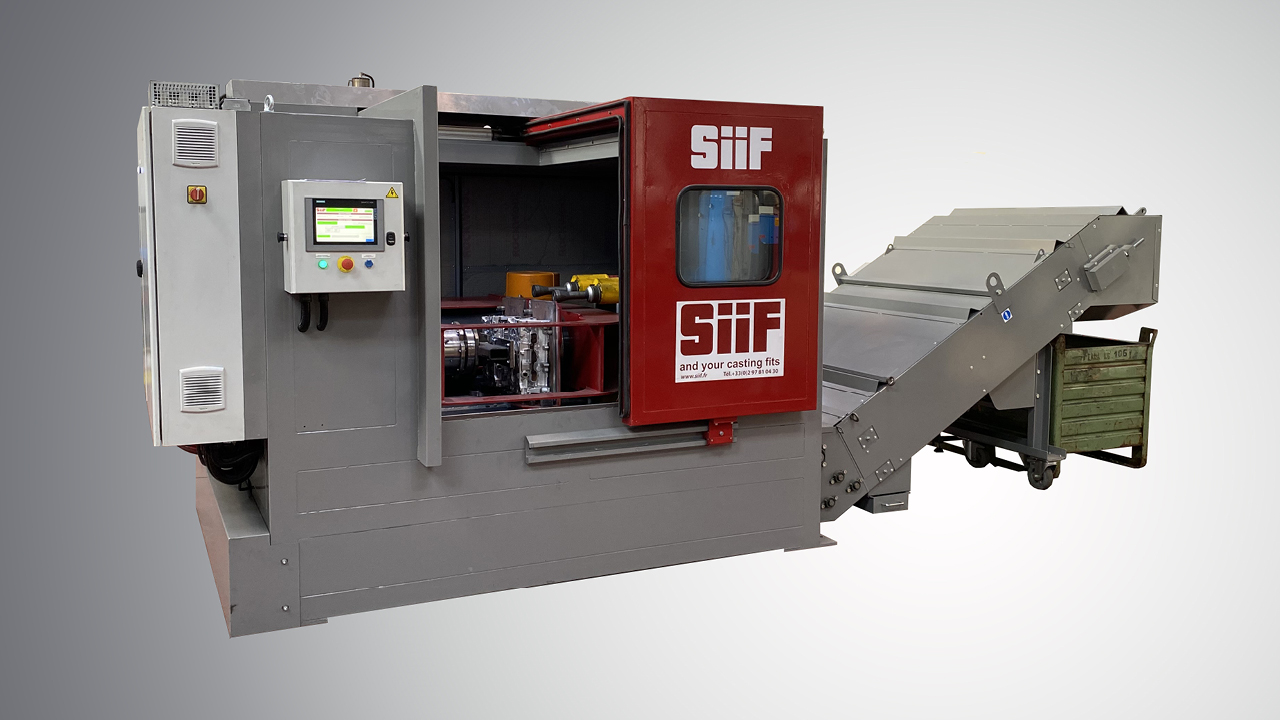
Decoring machine eliminates molding sand residues prior to finishing operations.
Grinding and Deburring : robotic cells vs. trimming press
Grinding and deburring removes flash, sprues, gates, and residual risers from raw castings. Present in nearly all casting processes, it has historically been the most labor-intensive finishing operation. And the one where automation has advanced most over the last 15 years.
Two main equipment families exist:
- Robotic finishing uses a robot arm fitted with interchangeable tools (grinding coated wheels, cutting disc, milling spindles) capable of handling varied geometries within a single cell (a major asset for foundries running diverse part numbers)
- Trim presses, conversely, use dedicated machine tooling to shear or trim parts: faster for high volumes of a fixed reference, but inflexible when changing part geometry
The choice between the two depends heavily on production volume and product mix, as detailed further in this article.
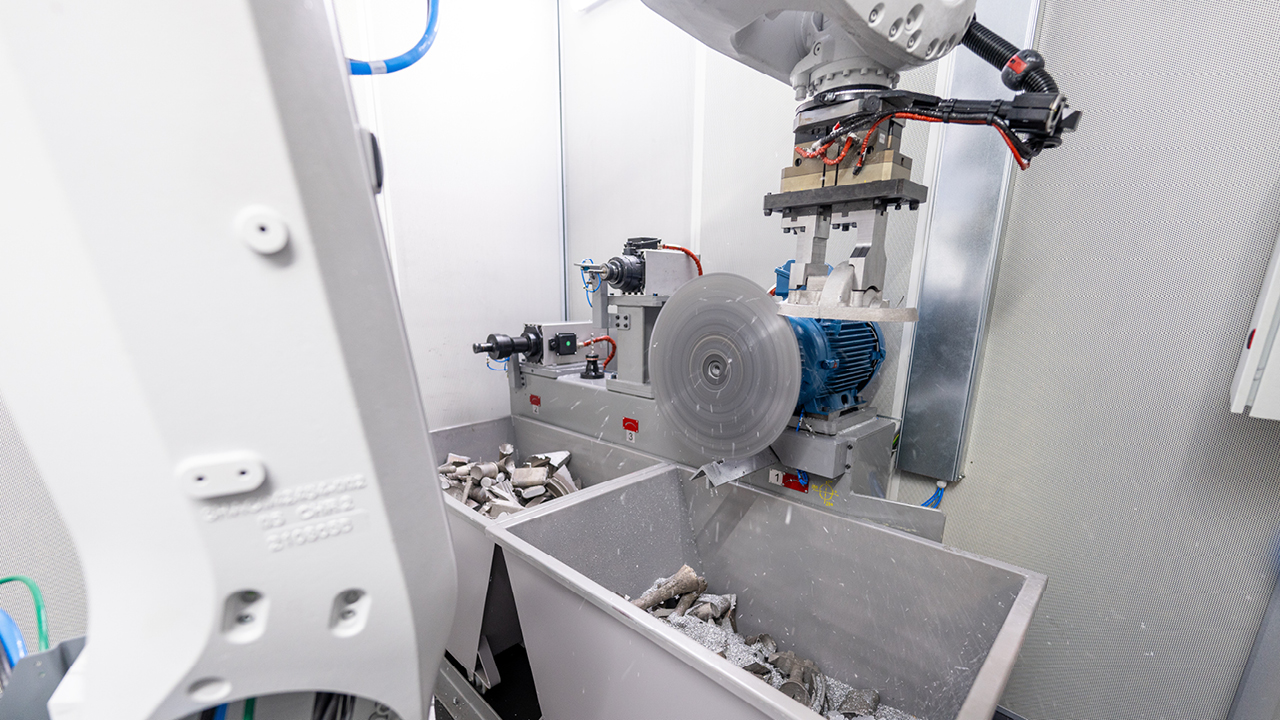
Robotic finishing
Sawing and pre-machining
On certain parts (particularly those cast in trees/clusters or with heavy risers) sawing complements deburring to cut off gate contacts. Pre-machining involves roughing critical dimensions or surfaces before final machining. Neither process is systematic; usage depends on part geometry and customer specs.
Automating these operations enhances dimensional repeatability, curbing scrap rates caused by out-of-tolerance dimensions caught late in final machining.
Vision systems and quality vision
Every casting undergoes inspection before shipping to verify dimensions, surface finish, and freedom from defects. Manual inspection relies on sampling, making 100% visual inspection impossible in high-volume runs.
2D and 3D vision systems change the game. Integrated at workstation outlets or directly inside finishing robotic cells, they compare every part against a 3D CAD reference model. They detect dimensional deviations, missing material, residual flash, or surface flaws on a part-by-part basis without slowing line speed.
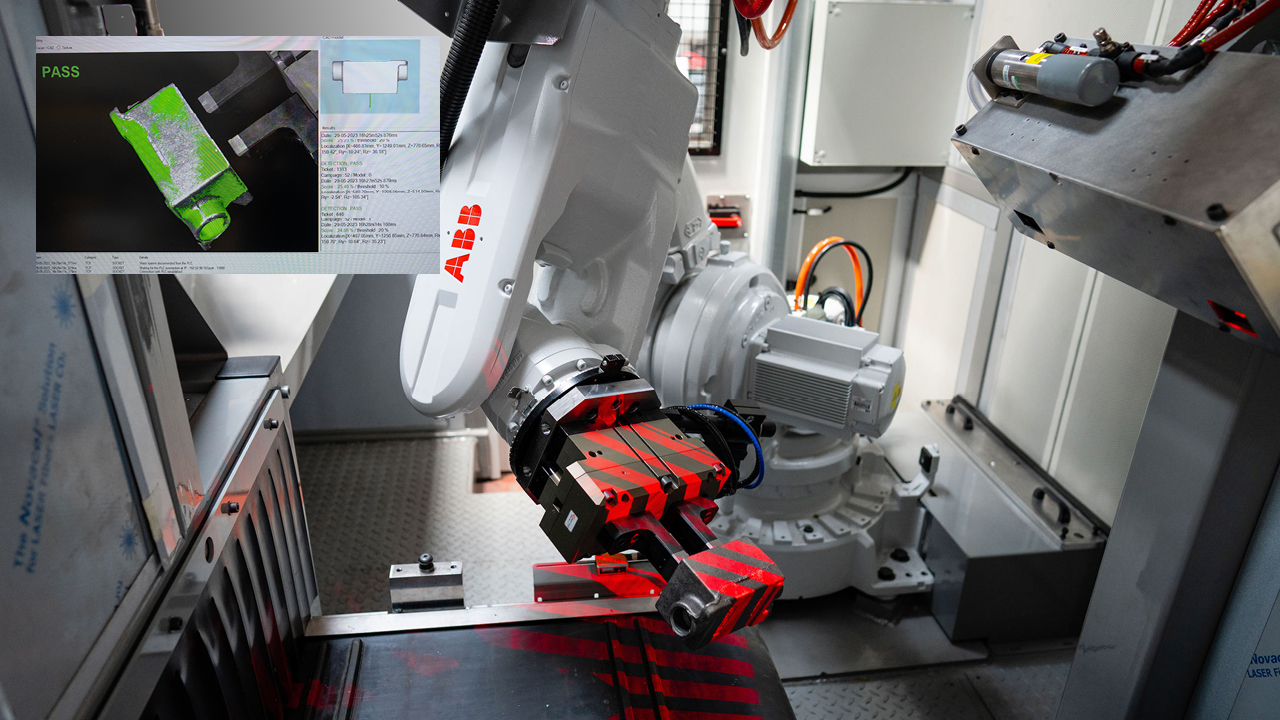
3D vision system
03/ Which technological solutions automate foundry finishing ?
Whether implemented standalone or combined, finishing activities leverage distinct equipment types depending on foundry requirements.
Versatile robotic cells vs. Dedicated standard machines
The primary technology choice lies between versatile robotic cells and single-operation dedicated machines. A robotic cell handles multiple operations (grinding, cutoff, sanding) across varying geometries via tool ranks (tool changing stations) and program swaps rather than hardware rebuilds. Dedicated machines process a single part faster but lack flexibility when product mix expands.
Robotic cells are available across vast payload ranges today. For instance, SiiF offers robotic cell ranges handling parts from a few pounds up to roughly 15 tons for heavy components. This spans small automative castings up to heavy rail or industrial parts (illustrating the broad scope of modern finishing automation).
In-cell machine vision (fixed ou robot-mounted)
A clear trend in modern finishing installations is embedding machine vision directly into the finishing cell (either fixed or mounted directly on the robot’s End-of-Arm Tooling (EOAT) or gripper. The camera scans the part prior to processing (for part localization, part re-indexing/alignment, quality inspection) automatically detecting deviations against CAD models.
Offline Programming (OLP)
The perception that automation is strictly for high-volume production remains widespread but outdated. The primary bottleneck for short-run automation isn’t hardware capability. It is downtime spent reprogramming the cell for every part changeover.
Offline Programming (OLP) directly solves this: robot paths are simulated and generated offline by a robotics programmerusing CAD models before parts ever hit the workshop. Setting up a new production run on the cell becomes vastly simpler. This is the exact approach SiiF takes with OLP software, catering directly to foundries managing high product variety in moderate volumes.
Standalone autonomous cells vs. Complete finishing lines
This choice ties back to a core principle: finishing is not an all-or-nothing proposition. A foundry can automate a single activity (such as a standalone robotic finishing cell) without modifying the rest of the facility. Alternatively, if multiple operations warrant automation, a fully integrated line can link vision system, decoring, trimming, and grinding/deburring with automated part transfer between stations.
The standalone route requires lower capital expenditure (CapEx) and suits foundries taking their first step into automation; SiiF, for example, offers standardized cells to optimize investment costs. Full lines maximize throughput gains but demand a broader rething of workshop layout. It is by no means a mandatory step when automating an isolated process.
04/ What are the limitations of foundry finishing automation?
Capital investment constraints
A robotic cell or automated decoring machine represents significant CapEx, including system integration and training. For foundries producing very low volumes across constantly changing part designs, ROI calculations can remain unfavorable (unless that high mix is offset by flexible solutions like OLP and multi-process cells. It is not an absolute barrier, but a factor requiring careful financial analysis beforehand.
Internalizing new skill sets
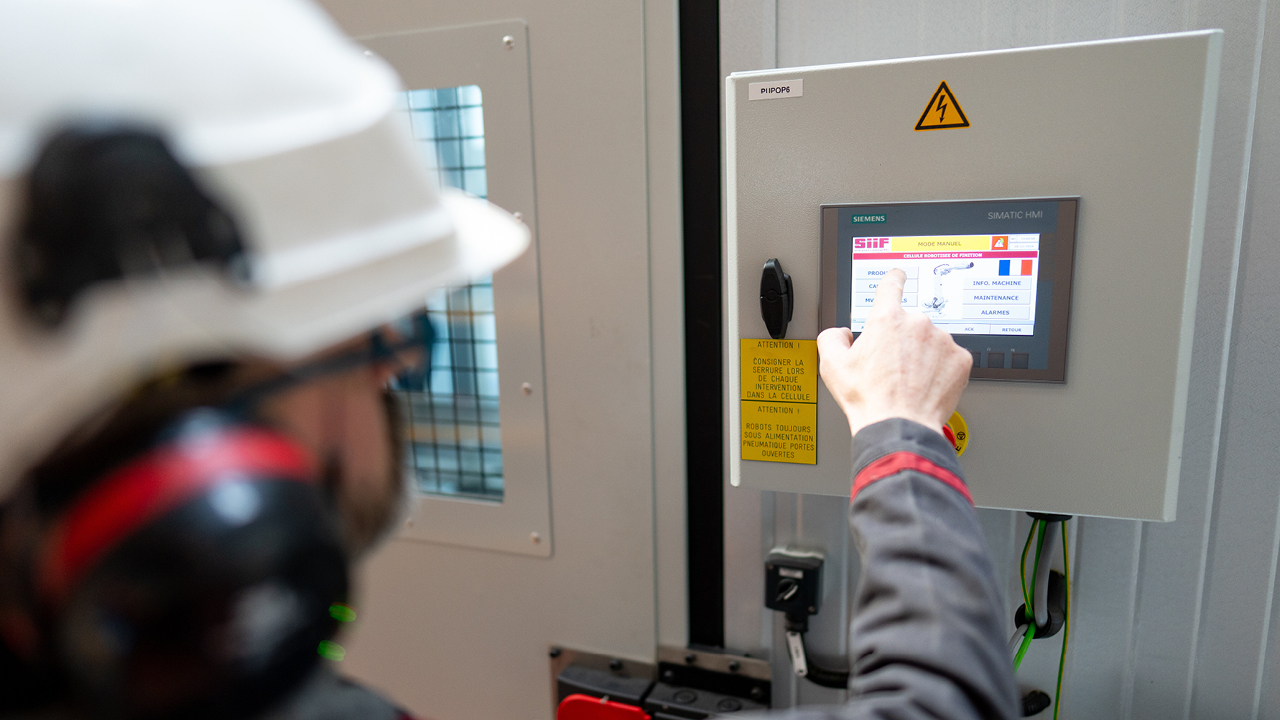
Automated cells do not run autonomously forever. They require operators who can supervise operations, set up new part runs, and perform basic maintenance. For workshops new to robotics, this requires a structured training plan and sometimes hiring dedicated technical personnel. While OLP minimizes programming overhead on the floor, it does not eliminate the need for skilled oversight.
Ramp-up productivity dip
Installing a new robotic cell almost always entails a tuning phase during which throughput way temporarily dip below manual levels as parameters are dialed in for each part number. Anticipating this in production schedules avoids surprises during rollout.
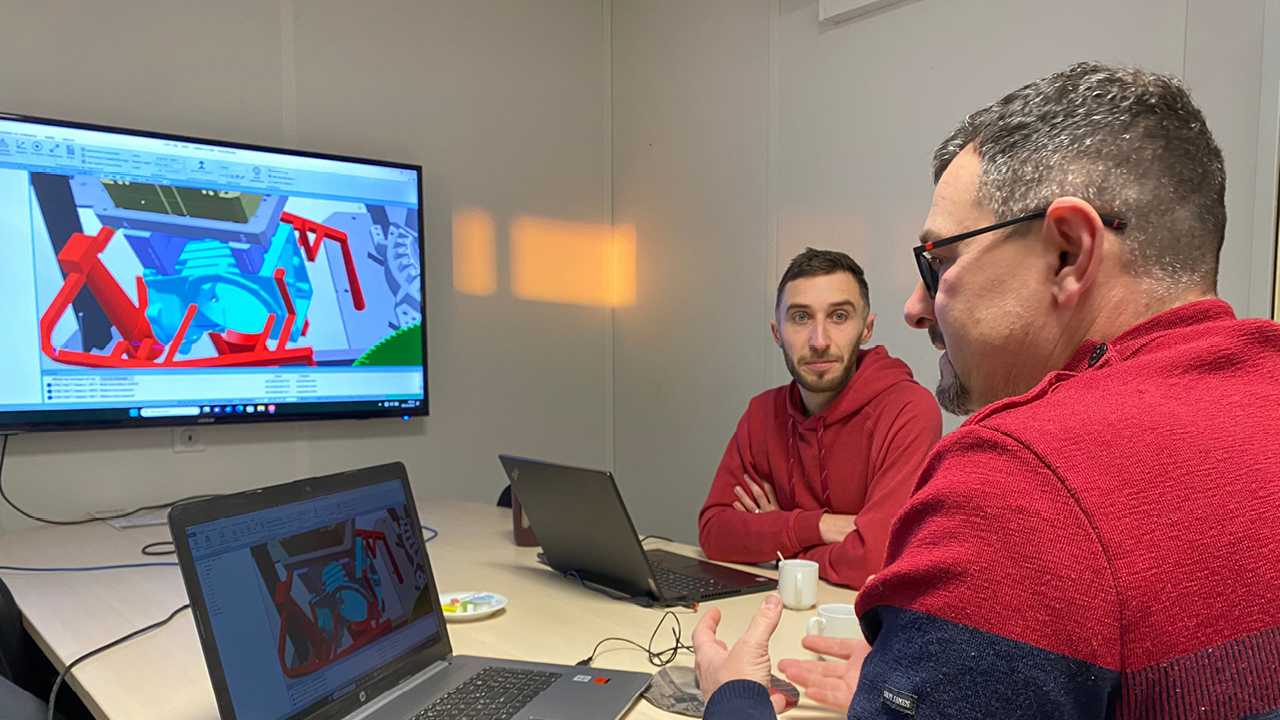
Training session
These limitations do not negate the value of automation; they simply form key variables when deciding which operation to automate first and whether combining multiple processes makes sense.
05/ How to choose the right automation solution for your foundry ?
Part geometry and alloys
Part weight, geometry, and material (gray/ductile iron, aluminum, steel alloys) strongly dictate system selection. A lightweight aluminum casting and a multi-ton iron casting require completely different robot payloads, end-of-arm tooling, and soundproofing enclosures.
Production volumes and product mix
High-volum foundries running identical parts have vastly different needs than high-mix, low-volume job shops. High-volume plants benefit from dedicated machines with faster cycle times on a single reference. High-mix plants achieve higher returns with versatile robotic cells paired with offline programming to minimize changeover downtime.
Calculating comprehensive ROI
Return on investment should rarely be evaluated on labor cost alone. On the investment side, factor in equipment costs along with integration, installation, workforce training, and the initial ramp-up period.
On the savings side, multiple factors compound:
- Reallocating labor to higher-value tasks
- Consistent cycle times and higher throughput once stabilized
- Reduced scrap rates from process consistency
- Hard-ti-quantify gains, such as lower absenteeism in high-strain work environments
Vendor support and service
Beyond machinery specifications, vendor support plays a critical role (especially for foundries lacking in-house robotics expertise. Operator training, field service, remote diagnostics/auditing, and new part setup support are just as decisive as mechanical specs.
For example, SiiF (a French OEM based in Caudan, Morbihan with over 30 years in foundry finishing equipment) combines hardware delivery with a dedicated training center. Beyond equipment suppliers, independent technical centers such as Cetim also assist foundries in assessing automation feasibility.
FAQ/ Foundry finishing automation
What is foundry finishing?
Finishing encompasses post-casting operations that convert a raw casting into a compliant final part: core settings, cooling, decoring, grinding, deburring, sawing, pre-machining, 2D/3D vision systems, and quality control. These are distinct operations rather than a fixed process; required steps depend on the casting method used.
Is finishing always a mandatory sequential chain of all these steps?
No. Each operation serves a specific requirement. For example, sand castings require decoring/shakeout, whereas permanent mold or investment castings do not. Foundries can automate a single operation without needing to integrate an end-to-end continuous line.
Which operations should be automated first?
Grinding/deburring and decoring (where applicable) are typically automated first because they are the most labor-intensive and physically demanding for workers? Quality control using vision system is often implemented in a second phase.
Is automation restricted to high-volume production?
No. Thanks to Offline Programming (OLP) and versatile robotic cells, automation is highly viable for moderate volumes and high product mixes, provided changeover times are kept low.
What is the difference between robotic finishing and trimming press ?
It comes down to product mix. Trimming press offer faster raw cycle times on a fixed, high-volume part number. Robotic cells excel when multiple part numbers run on the same cell, requiring only a software changeover rather than physical tooling swaps.
Can vision system inspect 100% of production parts?
Yes. A 2D or 3D vision system can inspect 100% of production in real time without bottlenecking cycle times, while logging defect data for full traceability (unlike manual inspection which relies on statistical sampling).
How long does it take to see ROI on a finishing cell?
There is no universal payback period. It depends on project CapEx, throughput volumes, reallocated labor, and scrap reduction. Calculations must account for total operational gains, not just initial purchase price.
Who provides foundry finishing automation solutions?
Several specialized OEMs operate in this sector. SiiF, based in Caudan, Morbihan (France), is a global specialist covering the full spectrum of finishing needs (from core settings to pre-machining) for iron, aluminum and steel castings.
Foundry finishing automation should not be viewed as a single, rigid project, but approached operation by operation: identify the biggest bottleneck or physical strain point on the workshop, measure the results, and then decide step-by-step whether to integrate additional steps. This phased approach reconciles productivity gains, consistent quality, and improved working conditions far better than a rigid, top-down overhaul.